
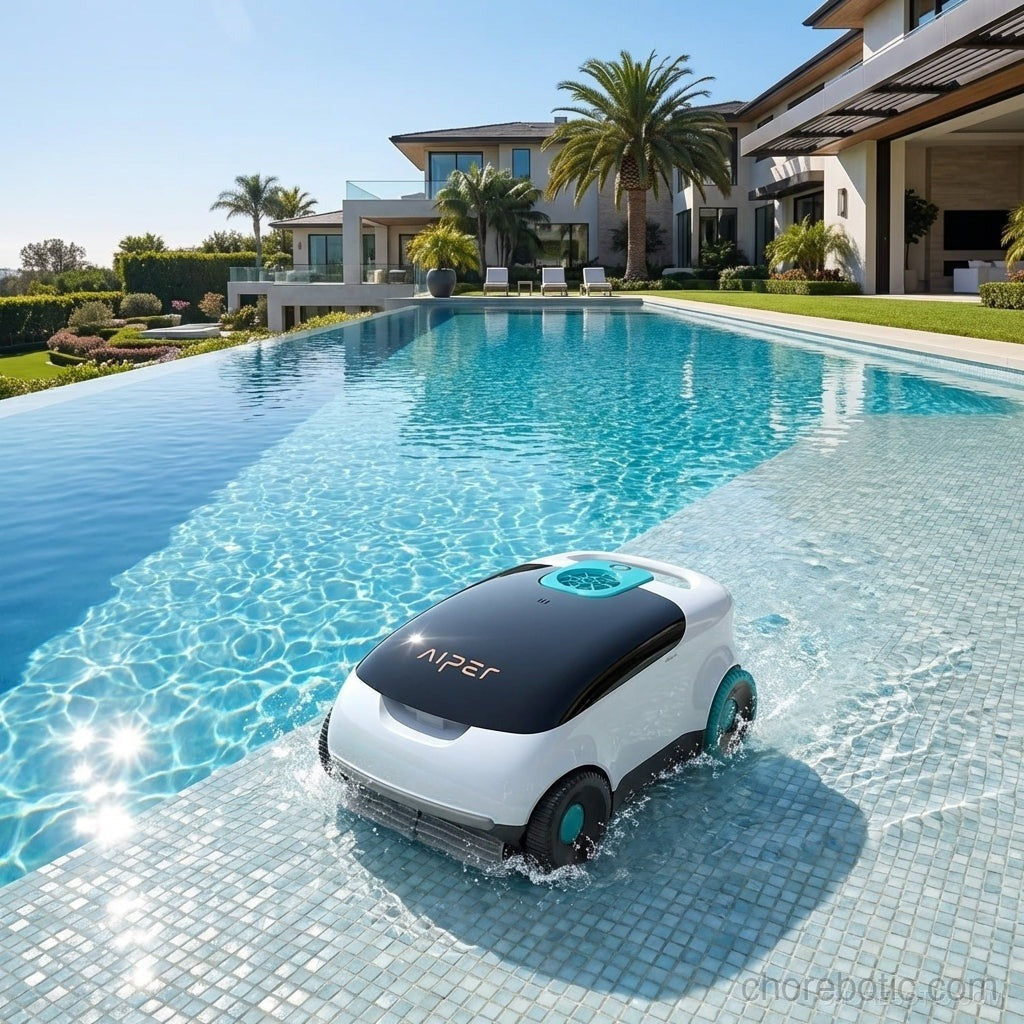
Above-ground pool owners get the short end of the pool-cleaner market. Most robotic cleaners are designed, priced, and marketed for in-ground pools — wall-climbing, waterline-scrubbing machines that cost four figures and solve problems you don't have. Meanwhile, what you actually need is simpler: something cordless, light enough to lift over the wall, gentle on a vinyl liner, and priced in proportion to the pool it cleans. This guide covers exactly that.
Quick answer: what's the best cordless cleaner for an above-ground pool?
For most above-ground pools, the Aiper Scuba 800 ($139.97) is the answer — a compact cordless robot built for flat-bottom pools up to roughly 860 square feet, which covers nearly every round and oval above-ground pool sold. If your pool is on the larger end or gets heavy debris, the step-up Aiper Scuba L1 ($299.97) adds capacity and cleaning muscle while staying above-ground-appropriate. Everything pricier than that is generally in-ground equipment you'd be overpaying for.
Why above-ground pools need a different cleaner
The above-ground environment differs from in-ground in five ways that matter for cleaner choice:
- Flat bottom, no deep end. Above-ground pools have a uniform floor. You don't need slope-handling navigation or deep-end suction strength — you need efficient flat-floor coverage, which is precisely what budget floor-focused robots do best.
- Vinyl liners are soft. Aggressive brushes and heavy tracked robots designed for gunite can stress a liner. Lighter cordless units with soft rollers are the liner-friendly choice.
- Walls aren't for climbing. Wall-climbing robots grip by suction force against rigid surfaces. Above-ground walls are thin, often flexible, and the waterline ring is easier to wipe by hand in two minutes than to buy a $1,000 feature for.
- You lift the robot over the wall. Every cleaning session starts and ends with hoisting the unit over a 48–54” wall, often up a ladder. A 15-lb robot is a one-hand job; a 25-lb in-ground flagship full of water is not.
- No poolside outlets (usually). Corded suction and pressure cleaners need plumbing or power at the pool. Above-ground setups rarely have either — cordless removes the question entirely.
In short: the features that justify premium in-ground robots are exactly the features above-ground pools can't use. Buying "less robot" isn't settling — it's buying correctly.
What actually matters when you choose
- Weight, wet. Check the robot's weight and remember it comes out of the pool full of water. Under ~15 lbs dry is the comfortable zone for over-the-wall retrieval.
- Coverage rating vs your pool size. A 24-ft round pool is ~450 sq ft of floor; an 18-ft round is ~254 sq ft; a 15×30 oval is ~450 sq ft. A robot rated for 860 sq ft covers all of these with margin.
- Runtime. Smaller floors need less time. 60–90 minutes of runtime finishes any above-ground pool; more is nice, not necessary.
- Filter fineness. Above-ground pools sit lower to yards and catch more grass clippings, pollen, and fine dirt. An accessible, rinseable fine-filter basket matters more than raw suction numbers.
- Liner-safe rollers. Soft PVA or foam rollers over hard scrubbing brushes.
- Price proportion. A sensible ceiling is 10–20% of what your pool cost. A $1,200 robot in a $4,000 pool is mismatched spend; $140–$300 is the rational band.
Our top pick: Aiper Scuba 800 — $139.97
The Scuba 800 is the definition of right-sized. It's a compact, fully cordless floor robot rated for flat-bottom pools up to about 860 square feet — more than double the floor area of a 24-ft round above-ground pool. Drop it in, and it runs a systematic floor pattern until the cycle ends, then waits for retrieval. No hoses, no cords over the wall, no booster pump.
Why it fits above-ground pools specifically:
- Light enough to lower and lift over the wall one-handed — the daily-use test that heavy robots fail
- Floor-only by design: you're not paying for wall-climbing your pool can't use
- Gentle rollers, vinyl-liner appropriate
- At $139.97, it's proportionate to the pool it serves — and to the risk tolerance of a first-time robot buyer
Honest limits: it's a floor cleaner for flat bottoms — it won't climb, won't skim the surface, and its runtime suits small-to-mid pools rather than marathon sessions. For a deeper look, we put it through a full evaluation in our Scuba 800 review.
The step-up: Aiper Scuba L1 — $299.97
If your pool is at the bigger end (large ovals, heavily-treed yards, or you simply want more cleaning authority), the Scuba L1 is the same above-ground-appropriate formula with more of everything: stronger pickup for leaf-heavy pools, longer effective coverage, and a larger debris basket that needs emptying less often. It remains a flat-bottom floor specialist — which is the correct spec, not a compromise — and stays light enough for over-the-wall handling.
Choose the L1 over the 800 when: your pool is 24 ft or larger, trees drop real debris loads, or you're replacing a manual vacuum you used more than twice a week.
Worth knowing about: the handheld option
For very small pools, spas, hot tubs, and quick touch-ups between robot runs, a cordless handheld like the Aiper Pilot X1 ($214.97) fills a different job: you steer it on a pole, it provides the suction. It's not an autonomous robot — but for an Intex-style soft-side pool under 15 ft, or as the spa companion to a robot-cleaned main pool, it's often the smarter tool.
Comparison table
| Scuba 800 | Scuba L1 | Pilot X1 (handheld) | |
|---|---|---|---|
| Price | $139.97 | $299.97 | $214.97 |
| Best for | Round/oval above-ground up to ~24 ft | Large above-ground, leafy yards | Soft-side pools, spas, spot cleaning |
| Cleans | Floor, autonomous | Floor, autonomous | Wherever you point it |
| Coverage | Flat bottoms to ~860 sq ft | Larger flat-bottom pools | Manual — unlimited, your arms permitting |
| Over-the-wall handling | Easy | Easy | N/A (pole-operated) |
And the honest word on premium robots: the wall-climbing, waterline-scrubbing machines — Aiper's own N1 Pro/N1 Ultra, Beatbot's AquaSense line — are superb in-ground equipment. If you also have (or upgrade to) an in-ground pool, our full model guide and N1 comparison map that territory. For above-ground, spend the difference on a season of chemicals instead.
Sizing guide by pool type
| Your pool | Floor area (approx.) | Recommendation |
|---|---|---|
| Intex/soft-side, 10–15 ft | 80–180 sq ft | Pilot X1 handheld, or Scuba 800 if you want autonomous |
| Round steel-wall, 15–18 ft | 180–255 sq ft | Scuba 800 |
| Round, 21–24 ft | 350–450 sq ft | Scuba 800 (fine) or L1 (leafy yards) |
| Oval, 15×30 and up | 450+ sq ft | Scuba L1 |
| Semi-inground / walled flat-bottom | varies | L1; consider N1 line only if walls are rigid and you want them scrubbed |
The above-ground buyer's trap (and how review sites set it)
Search "best robotic pool cleaner" and nearly every list you'll find is built around in-ground flagships, with maybe one budget pick at the bottom — because review sites earn bigger commissions on $1,200 robots than $140 ones. The result is a predictable failure pattern we hear about constantly: an above-ground owner buys a mid-range in-ground robot "to be safe," then discovers it's exhausting to lift over the wall, its wall-climbing feature does nothing, its tracked weight worries their liner, and its price would have covered three seasons of chemicals.
The correction is a single mental flip: above-ground pools aren't the budget tier of pool ownership — they're a different spec sheet. Flat floor, soft liner, wall you lift over, smaller water volume. Judge every cleaner against those four facts and the market sorts itself instantly: two or three right-sized cordless models make sense, and everything else is somebody else's equipment.
The budget math: robot vs the alternatives
It's worth seeing what the $140 actually replaces:
| Approach | Upfront | Ongoing | Your time |
|---|---|---|---|
| Manual vacuum kit (head + hose + pole) | $50–$100 | replacement hoses/heads | 30–45 min per cleaning, 2–3×/week, all season |
| Pool service visit | — | $80–$150/visit | none, but scheduling and strangers in the yard |
| Cordless floor robot | $139.97–$299.97 | rinse the basket; battery care | ~3 minutes per cleaning |
A manual kit costs less on day one and then quietly charges you 60+ hours of labor per season. A robot pays for itself against a single month of service visits — and against manual vacuuming, it pays you back in July afternoons. This is why the robot is the rational default even for a modest pool, as long as the robot is priced like above-ground equipment.
Solving the classic above-ground cleaning problems
The dirt ring where floor meets wall. The cove (that curved floor-to-wall seam) collects fine dirt that manual vacuums skid over. Floor robots handle the flat expanse; run your pool brush along the cove weekly and let the robot collect what you loosen on its next pass — a two-minute assist that keeps the whole floor uniform.
Algae dust after treatment. Post-algaecide, dead algae settles as fine grey dust. Run the robot the morning after treatment, rinse the filter thoroughly (it will be genuinely dirty), and run once more. This two-pass pattern beats one long run because the filter clogs midway through heavy dust loads.
Grass clippings every mow day. The pool sits in the yard; the yard visits the pool. The fix is sequencing, not equipment: skim after mowing, give clippings an hour to sink, then run the robot. Clippings caught the same day rinse out of a filter basket easily; clippings left for days become mush that packs it.
Pollen season haze. Pollen is fine enough to pass coarse filters and settle back. It's the one debris type where filter fineness matters most — rinse the fine basket after every pollen-season run, and expect to run daily for the worst two weeks. Your filtration system handles what's suspended; the robot handles what settles.
The "it missed a spot" instinct. Same advice as every robot in this cluster: judge coverage over two or three cycles, not one. Systematic-coverage robots vary their pattern between runs; the untouched patch near the ladder gets its turn.
Above-ground care habits that keep a robot happy
- Retrieval without the swim: both Scubas surface-park near the wall at cycle end; guide them the last foot with your pool pole rather than leaning over the wall — ladders and wet hands don't mix.
- Mind the liner floor wrinkles. Big liner wrinkles can slow any floor robot. Smooth persistent wrinkles (a liner-care task anyway) and the robot's coverage improves noticeably.
- Rinse after every run. Above-ground pools run smaller water volumes, so chemical concentrations swing higher — residue rinse-off matters even more than in-ground.
- Charge indoors, always. The full routine is in our setup guide (identical across Aiper's line), and if charging ever misbehaves, the troubleshooting guide resolves most cases in minutes.
- Storage: above-ground pools close earlier and harder than in-ground — when the pool winterizes, the robot goes indoors at half charge, above freezing, with a mid-winter top-up.
Frequently asked questions
Do robotic pool cleaners work in Intex and other soft-side pools?
Yes, with the right pick. Light floor robots like the Scuba 800 work well on soft-side pool floors; heavy tracked robots don't belong there. For the smallest soft-sides (under ~12 ft), a handheld is often more practical than any robot.
Will a robot damage my vinyl liner?
Above-ground-appropriate cleaners with soft rollers are liner-safe — they're far gentler than a manual vacuum head scraped along the floor. What stresses liners is heavy in-ground machinery and aggressive bristle brushes, which is one more reason not to over-buy.
Do I need a wall-climbing cleaner for my above-ground pool?
No. Above-ground walls aren't suited to climbers, and the waterline is a two-minute hand-wipe. Wall-climbing is an in-ground feature — paying for it in an above-ground pool is the most common over-purchase we see.
How often should I run it?
Two to four times a week in season. Above-ground pools sit closer to grass and dirt, so pollen and clippings arrive constantly — frequent short runs beat occasional deep cleans.
Can I leave the robot in the pool?
No — take it out after each cycle, rinse it, and store it shaded. Continuous immersion ages seals and is the leading cause of early cordless-robot failure.
What about winter?
When you close the pool, the robot moves indoors: cleaned, dried, charged to about half, stored above freezing. One mid-winter charge top-up protects the battery for spring.
A realistic above-ground season, week by week
Opening week: above-ground pools open messier than in-ground — smaller volume means winter's debris is more concentrated. Net the big stuff, balance chemistry, run filtration a full day, then give the robot its hardest week: daily runs, rinsing the basket after each until it comes up mostly clean. Don't judge the robot on opening week; judge it on week three, when it's maintaining rather than excavating.
Peak season (June–August): two to four runs weekly, mornings, after skimming. Small-volume pools heat up fast, and warm water grows things fast — consistent floor cleaning removes the organic food that algae wants. Keep the chemistry honest and the robot makes chemistry easier: less debris means chlorine works on water, not leaves.
Storm and swim-party recovery: the above-ground advantage is speed — a robot cycle plus a skim returns a modest pool to clean in an afternoon. Skim first, wait an hour for sinking, run the robot, done.
Closing (September–October in most of the country): run a final cycle the day before closing so the pool winters clean — spring-you inherits the difference. Then the robot's winter routine from our setup guide: deep rinse, full dry, half charge, indoors above freezing, one top-up in January. Above-ground robots that winter in the shed die young; the ones that winter in the basement outlive the liner.
Total honest labor across that season: a few minutes per run, a weekly cove brush, and one afternoon at each end. That's the entire above-ground cleaning story once the right-sized robot owns the floor.
The bottom line
Above-ground pool owners win by buying proportionally: a light, cordless, floor-focused robot matched to a flat bottom and a vinyl liner. For most pools that's the Scuba 800 at $139.97 — the cheapest "never manually vacuum again" ticket in pool care — with the Scuba L1 as the big-pool, big-debris upgrade. Skip the four-figure wall-climbers; your pool literally cannot use what they charge for.
Shop cordless pool cleaners at ChoreBotic → — free standard shipping on orders of $50 or more, 30-day returns (conditions apply).
Share:
Aiper Pool Cleaner Not Charging? Troubleshooting Guide (2026)
Fishing Drones 101: How Bait-Release Drones Actually Work (2026)